
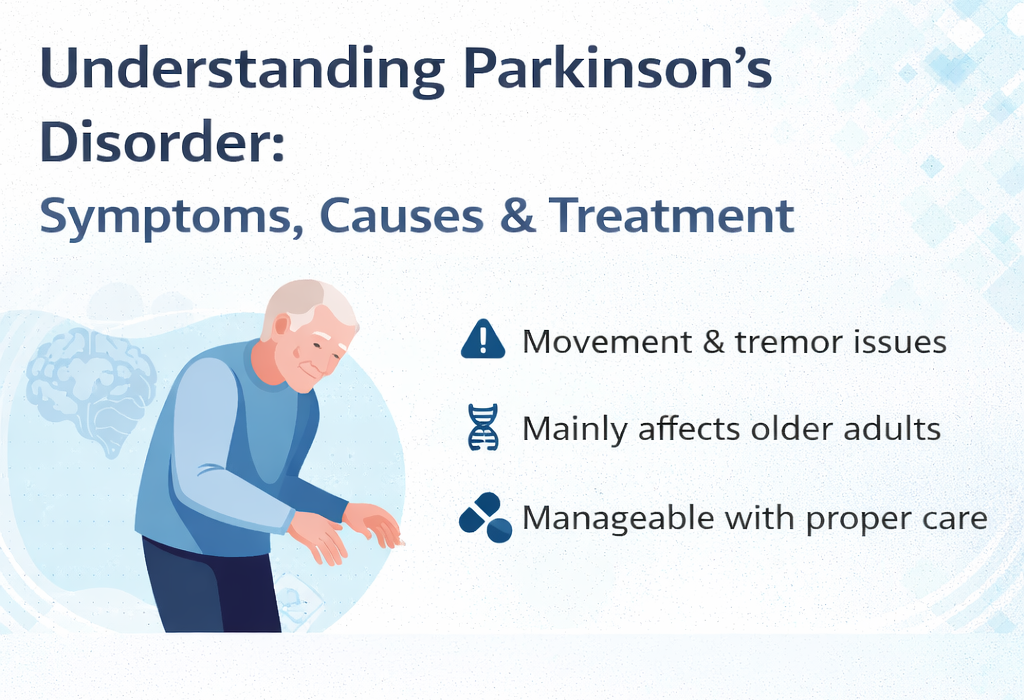
Understanding Parkinson’s Disorder: Symptoms, Causes & Treatment
Parkinson’s Disorder is a progressive neurological condition that affects movement, balance, and coordination. It develops gradually and is commonly seen in people above the age of 60, although younger individuals can also be affected.
What is Parkinson’s Disorder?
Parkinson’s occurs when certain nerve cells in the brain (especially those producing dopamine) become damaged or die. Dopamine is essential for smooth and coordinated muscle movements.
When dopamine levels drop, it leads to slowness, stiffness, and tremors.
Common Symptoms of Parkinson’s
Symptoms may vary from person to person, but the most common include:
- Tremors (shaking of hands, fingers, or legs at rest)
- Slowness of movement (Bradykinesia)
- Muscle stiffness and rigidity
- Balance problems and frequent falls
- Speech changes (soft or slurred voice)
- Reduced facial expressions (masked face)
What Causes Parkinson’s?
The exact cause is still unknown, but several factors may contribute:
- Ageing
- Genetic factors (family history)
- Environmental exposure (toxins, chemicals)
- Brain cell degeneration
How is Parkinson’s Diagnosed?
There is no single test to confirm Parkinson’s. Diagnosis is based on:
- Clinical examination by a neurologist
- Medical history
- Response to Parkinson’s medications
- In some cases, brain imaging (MRI/CT)
When to See a Doctor?
Consult a neurologist if you notice:
- Persistent tremors
- Slowness in daily activities
- Balance or walking issues
Early intervention helps in better management.